

Wellington-Altus Newsroom

Keep up-to-date with our current happenings

> Home  | Newsroom

Earlier or Later? Deciding When to Start Canada Pension Plan Retirement Benefits

Many individuals approaching retirement wonder if there is an optimal age to begin taking their Canada Pension Plan retirement pension benefits (CPP). The question often arises because CPP is calculated based upon the age at which an individual starts to receive monthly payments. Though the standard age to start CPP is 65, Canadians can start receiving CPP as early as 60 or as late as 70.

The standard CPP entitlement at age 65 is reduced by 7.2% for every year (0.6% per month) taken before 65 and is increased by 8.4% for every year (0.7% per month) taken after 65.


Should individuals defer taking CPP to take advantage of the increased CPP benefit entitlement? It depends.
The CPP breakeven age is a good starting point to evaluate one’s options; however, it should not be the sole factor in deciding.

What is the CPP breakeven age?

This concept is best explained with an example. Let’s assume Peter and Paul are both 60 years of age in 2022 and will be eligible for the maximum CPP benefit at age 65. For 2022, the maximum benefit at age 65 is $1,253/month ($15,036 per year).

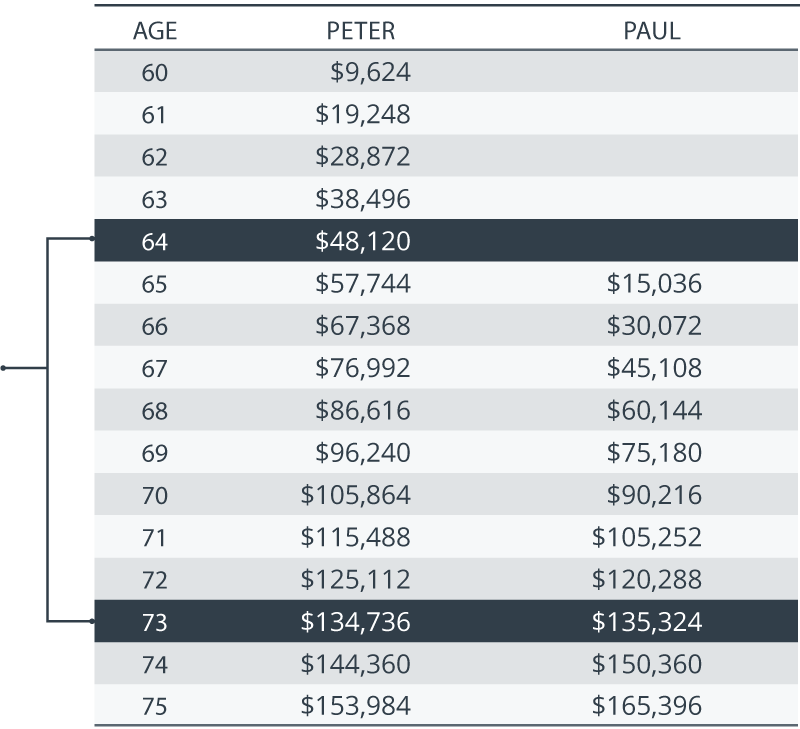
Peter decides to take CPP now at age 60, and as a result his benefits are reduced by 36% to $802/month or $9,624 per year. Paul decides to wait until age 65 to start collecting his CPP benefits. The table on the right demonstrates the cumulative annual CPP payments they will each receive.

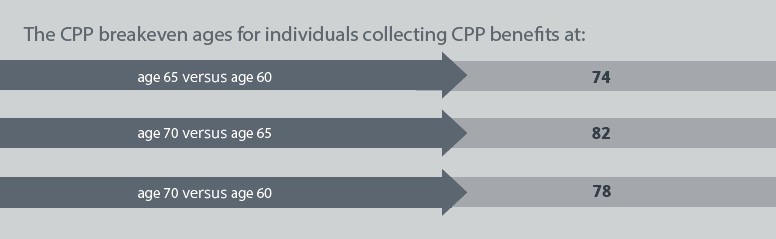
Peter has collected almost $50,000 before Paul has received his first CPP benefit payment. The general perception is that Peter will be permanently better off financially. This is incorrect. If Paul lives beyond the breakeven age of 74 (73.9 to be exact), he will not only catch up to Peter, but he will also receive greater benefits than Peter for having delayed receipt of his CPP to age 65.

This analysis does not consider annual inflation adjustments to CPP benefits, which may further increase the pension entitlement of an individual who chooses to delay receipt of their CPP benefits.

Key takeaways

Consider starting CPP early if…

  • Your current health (or your family history) suggests you might have a shortened
    life expectancy,
  • You wish (or need) to retire early but lack sufficient savings, income and cash flow to achieve your retirement lifestyle requirements.

Consider delaying CPP early if…

  • There is a family history of  longevity and you are in great health,
  • You expect to remain in the workforce but don’t yet qualify for the maximum CPP entitlement.
    These additional years of earnings will increase your basic CPP pension.

Share This Article:

Newsroom Featured image Wellington-Altus logo

Why Planning?

At the Advanced Wealth Planning Group at Wellington-Altus, we’re strong advocates for financial planning. And while most Canadians share that view, we recognize that not everyone sees things the same way. This article aims to share our perspective on financial planning, particularly with those who may not yet see its full value.

READ MORE »
Newsroom Featured image Wellington-Altus logo

Deadline Reminder: 2025 Prescribed Rate Loan Interest Payment

What is a prescribed rate loan?

A prescribed rate loan is one of the few income-splitting opportunities provided to Canadians that does not violate the various “attribution rules” found in Canada’s Income Tax Act. These “attribution rules” are designed to prevent high-tax bracket individuals from shifting investment income to a lower-tax bracket individual’s hands.

READ MORE »
Newsroom Featured image Wellington-Altus logo

Understanding the Disability Tax Credit

With over 8 million Canadians living with a disability,1 chances are you or someone close to you is navigating its daily impacts. The Disability Tax Credit (DTC) can open doors to vital supports and broader services that promote financial security and well-being. Here’s a look at who qualifies and how it helps.

READ MORE »
Newsroom Featured image Wellington-Altus logo

Understanding The DTC Application Process

The Disability Tax Credit (DTC) is a non-refundable tax credit designed to support Canadians living with severe and prolonged impairments. It can bring significant value for eligible individuals and families, not only through financial support, but also by opening the door to a range of additional programs and services. To apply, individuals must complete Form T2201 Disability Tax Credit Certificate (“Form T2201”), which requires both personal and medical information. Understanding the application process is essential to ensuring a smooth, efficient, and hopefully successful application.

READ MORE »

The information contained herein has been provided for information purposes only. The information does not provide financial, legal, tax or investment advice. Wellington-Altus Financial Inc. (Wellington-Altus) is the parent company to Wellington-Altus Private Wealth Inc. (WAPW), Wellington-Altus Private Counsel Inc. (WAPC), Wellington-Altus Insurance Inc. (WAII), Wellington-Altus Group Solutions Inc. (WAGS), Independent Advisor Solutions Inc., (IAS) and Wellington-Altus USA. Wellington-Altus (WA) does not guarantee the accuracy or completeness of the information contained herein.

©2025 Wellington-Altus Private Wealth Inc., Wellington-Altus Private Counsel Inc., Wellington-Altus Insurance Inc, Wellington-Altus Group Solutions Inc., Independent Advisor Solutions Inc., and Wellington-Altus USA. ALL RIGHTS RESERVED. NO USE OR REPRODUCTION WITHOUT PERMISSION. www.wellington-altus.ca