SECURITY AND REDUNDANCY ARE REDIRECTING CAPITAL
Security, redundancy and domestic capacity are changing where capital is deployed, but greater spending does not guarantee stronger investment returns.
For much of the past three decades, businesses pursued a straightforward objective: produce more efficiently, source from the lowest-cost suppliers, and minimize excess capacity. In tandem with this objective, global supply chains became increasingly specialized. With just-in-time inventory systems reducing costs, companies concentrated production in locations offering the greatest economies of scale.
That model delivered substantial benefits; it also created dependencies that have become harder to ignore during sustained periods of geopolitical tensions, trade restrictions and energy disruptions.
Now, governments and businesses are responding by placing greater value on economic security, even when achieving it requires higher upfront investment. For investors, this changes both where capital may flow and how potential beneficiaries should be evaluated.
Efficiency Is No Longer Enough
The International Energy Agency’s Global Critical Minerals Outlook 2026 projects strong growth in demand for minerals used in energy technologies. The same outlook highlights the geographic concentration of mining and refining, which can leave industries exposed to a disruption in one major processing location.¹
The challenge extends beyond extracting raw materials to processing facilities, specialized equipment, technical expertise and manufacturing capacity. Building alternative supply chains requires investment across the production process, often with substantial capital requirements and long development timelines.
A company may accept higher procurement costs, hold additional inventory or maintain a second supplier in exchange for more reliable access to essential inputs. The relevant question is whether the reduction in potential disruption justifies the added cost.
Investment Priorities Are Changing
This shift is influencing capital spending across electricity grids, transportation infrastructure, industrial automation, cybersecurity, critical minerals and domestic manufacturing.
The 2024 Draghi report on European competitiveness estimated that the European Union would need hundreds of billions of euros in additional annual investment to support its energy, digital, defence and security priorities.² Canada is pursuing similar objectives through its Critical Minerals Strategy, which emphasizes domestic production, processing, manufacturing and recycling, as well as supply relationships with international partners.³
Investment in these areas can serve several purposes:
These needs create durable pools of demand, but they don’t make every company serving them an attractive investment.
A Growing Market Does Not Guarantee Attractive Returns
For example, a government commitment to expand domestic mineral processing can create demand for new facilities and equipment. Yet, projects still require substantial upfront investment, face lengthy permitting processes, and encounter cost overruns before generating revenue.
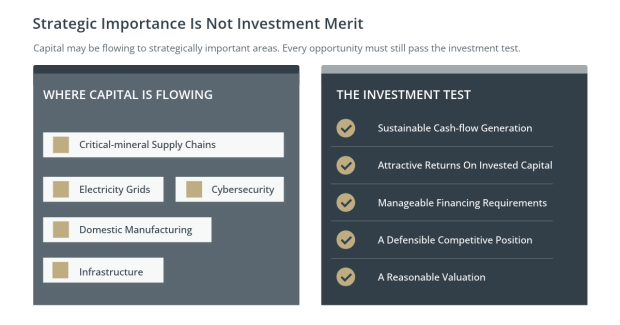
Even when demand materializes, profitability depends on the competitive environment. An industry experiencing rapid investment might eventually develop excess capacity, putting pressure on prices and returns. While government support in the form of subsidies, procurement commitments and other incentives can improve project economics, changes in policy or funding also affect their value.
For investors, the relevant distinction is between exposure to an attractive theme and ownership of an attractive business. Sustainable cash flow, returns on invested capital, financing requirements and valuation remain essential measures. Strategic importance may support demand, but it does not eliminate commercial risk.
The Implications For Investors
Reassess your exposure to supply chain disruption, look for overlap across holdings, and evaluate which investments have the potential to convert structural demand into attractive returns on capital. Several investments in industrials, energy, infrastructure and materials may appear diversified, but they still depend on the same government programs, commodity cycles or financing conditions. Understanding those common drivers helps separate genuine diversification from repeated exposure to one economic thesis.
The shift toward security and redundancy is changing investment priorities, not suspending the fundamentals of investing. The enduring opportunity lies with businesses that can convert greater demand for reliability into sustainable cash flow and attractive returns on capital.
Sources
1. International Energy Agency, Global Critical Minerals Outlook 2026.
2. European Commission, The Draghi Report on European Competitiveness.
3. Government of Canada, The Canadian Critical Minerals Strategy.