
A transfer plan must address ownership, control and readiness, not only who receives an asset.
In Canada, the transfer of substantial wealth is already underway, yet many succession plans remain incomplete. The reasons for delay are often understandable: a desire to preserve flexibility, uncertainty about how to divide assets, or concerns about a successor’s readiness.
Delay has a cost though, as fewer options remain after an illness, conflict, death or unsolicited offer forces decisions onto a compressed timeline.
According to the UBS Global Family Office Report 2026, 57% of surveyed family offices had wealth succession plans for family members. At the same time, having a plan did not mean the next generation was prepared to participate in decisions. Among next-generation family members considered old enough to participate, only 13% were fully involved in decision-making, while 21% had no involvement at all. ¹
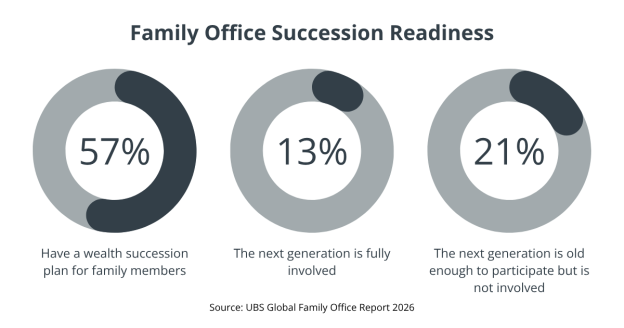
These findings point to an issue that legal documents alone cannot resolve. A technically sound estate plan may specify who receives an asset without preparing that person to own it, manage it or participate in decisions. The people affected by a plan need enough information and time to understand the responsibilities it creates.
Transferring Ownership and Control
Succession becomes more complicated when transferring a business also means shifting responsibility for its management. In some cases, professional executives may assume responsibility for daily operations, while ownership remains within the family. In other cases, selling a business to management, employees or an outside buyer can provide a path for the business to continue under new ownership.
These arrangements require clarity about decision rights:
The answers may involve shareholder agreements, governance structures and coordinated legal, tax and financial advice. Without that clarity, a completed ownership transfer leaves unresolved questions about how the business or other assets will be managed.
A Wider Set of Succession Paths
Succession does not always mean a parent-to-child transfer. Business owners may prefer a management buyout, an employee-ownership structure or a third-party sale. Individuals without children or intended family successors may be planning transfers to spouses, relatives, trusts or charitable organizations.
Recent changes to Canada’s Employee Ownership Trust (EOT) rules have introduced tax incentives that may make selling a business to employees more attractive for eligible owners, including a capital gains exemption of up to $10 million on qualifying sales.² While the incentives may make this approach more appealing, a successful transition still requires careful consideration of valuation, financing, governance and tax implications.
Each path has different implications for control, liquidity, taxation and the future of the underlying asset. The most appropriate approach depends on the owner’s objectives and the readiness of those expected to assume responsibility.
Build The Plan in Stages
Succession planning often begins with an understanding of the owner’s objectives, existing ownership arrangements and the readiness of potential successors. Financial considerations, including the liquidity required to support a transition, also play an important role. These factors help inform the evaluation of different succession paths and the legal documents, governance arrangements, insurance or financing that may be required.
This staged approach does not require every future decision to be fixed today. Instead, it creates a framework that can evolve as circumstances change while ensuring that critical information, authority and funding do not depend on one person’s availability.
Estate counsel, tax professionals, valuation specialists and corporate advisors each address different technical issues. As your wealth advisor, we can help connect their recommendations to portfolio liquidity, investment risk and your wider objectives.
Succession planning is about more than determining who receives an asset. It establishes who will make decisions, how responsibilities will transfer, and whether the people and financial resources needed to support that transition are in place. A plan can evolve as circumstances change. Its value lies in ensuring that essential decisions are made deliberately rather than under the pressure of an unexpected transition.
Sources
1. UBS, Global Family Office Report 2026
2. Department of Finance Canada, press release